

The Development of the Rocket Rescue Apparatus & Breeches Bouy
Southwold, like so many places around our coast, played their part in trying to keep sailors safe from the sea by having lifeboat stations and by having a rocket volunteer service which operated from the late 1800’s to 1988.
In the early 19th century, people watching a ship run aground close to shore were unable to help due to the stormy conditions and often had to watch people drown.
In 1807, a young George Manby watched HMS Snipe run ashore off Great Yarmouth with many sailors drowning. It eventually led to his development of what came to be known as Rocket Apparatus which subsequently developed into the Breeches Buoy.
At the tender age of 18, remembering the Snipe incident led him to experimentally fire a line from a mortar over Downham Church and later with mortars firing a line with a grappling hook to a ship foundering near shore. The thin line, when caught by the crew, would be used to pull in a more substantial rope.
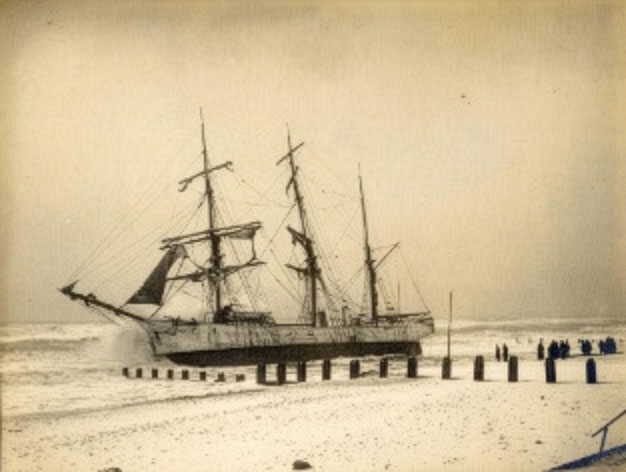
The Idun was too close to the shore for the lifeboat to rescue the crew
Ongoing successful rescues using the apparatus at Great Yarmouth and Winterton led to its official adoption and the apparatus was established at mortar stations around the coast.
In Cornwall around the same time, Henry Trengrouse witnessed the wrecking of HMS Anson at Mount’s Bay, Cornwall with significant loss of life. He resolved to devise a method of saving lives from wrecks and came up with a system which he termed a “Bosun’s Chair” – later to be called the Breeches Buoy.
In 1826, the Royal National Institution for Saving Life from Shipwreck supplied rockets in four locations on the Isle of Wight. The first real life rescue was at Bembridge in 1832. By 1853 there were 120 such stations around the UK including Southwold where the local people trained regularly to ensure we would be ready for any shipwreck.
Southwold’s Contribution
On Southwold Common, there was erected a ships mast known locally as the “Fiddle Pole”. There, the members of the Rocket Apparatus Volunteers Service would practise the firing of the rocket and setting up the breeches Bouy. It was a great opportunity for us young boys to have a ride on the Breeches Bouy as they practised the operation.
My Father was one of many Southwold residents who volunteered for this service and, along with other local volunteers, he received his Long Service Medal and Bar for 40 years’ service.
In the UK the “Breeches Buoy” rescue system using the rocket system was officially withdrawn from service in 1988.

Arthur Thompson receiving his Long Service medal


The Alfred Corry Museum
Frank Upcraft. our former curator. managed to get a Breeches Buoy and had the idea of “rescuing” young visitors and allowing them to be pulled around the museum.
Unfortunately, “health and safety” considered this too risky so a Panda was placed in the Breeches Buoy. It is now a favourite for our younger visitors who watch the panda being rescued as they pull on the rope.
A Plea for Volunteers
We have a mostly ageing population of stewards and have been unable to open as often as we would have liked during this last year. We are making a request for people to consider helping at the museum.
Volunteers will receive training and will be accompanied by another steward. During the summer, we open for 3-hour shifts which can be adaptable to people’s normal routines.
If you would like to come along, have a look around and a chat to see if you might be interested in helping keep this piece of local maritime history alive, please feel free to contact me, Jamie Thompson, on 07770 625851 or at jamie@alfredcorry.co.uk

This volunteer is a bit young but we hope she will join us in a few years
